
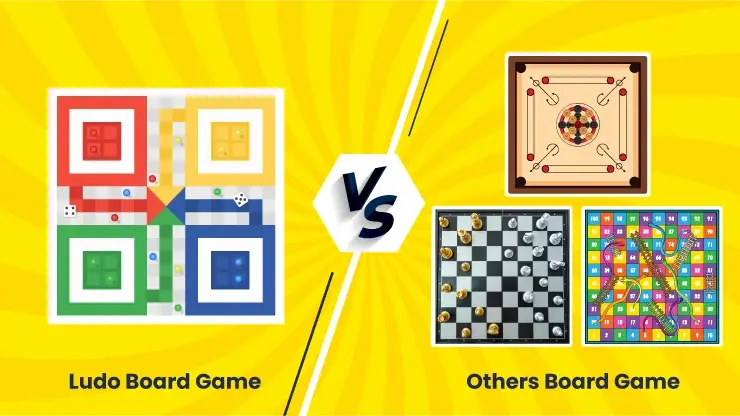
Board games have always been a favorite way to spend time with family and friends. But have you ever wondered what makes Ludo stand out compared to other board games? From its simple rules to the excitement it brings, Ludo has a charm that keeps players hooked. On the other hand, classic board games like Chess or Monopoly bring their unique twists and challenges.
In this article, we’ll explore Ludo vs. other board games and compare how it holds up against other classic board games.
Comparing Ludo With Classic Games
Ludo is a timeless game that combines strategy, decision-making, and quick thinking in a simple, engaging format. To better understand its appeal, it’s helpful to compare Ludo with other classic board games like Chess, Snakes and Ladders, and Monopoly. While each game has its own style and challenges, Ludo stands out for its balance of accessibility and strategic depth, making it enjoyable for players.
The table below helps show how Ludo compares with board games similar to ludo such as Chess, Scrabble, Monopoly, Carrom, Snakes & Ladders, and Checkers.
| Game | Gameplay Type | Skill Required | Verdict |
|---|---|---|---|
| Ludo | Race-to-home movement with decisions on blocking, capturing, and token positioning | Tactical planning, timing, and adaptability | Great for families and quick sessions; easy to learn with depth in movement strategy |
| Chess | Structured piece movement aiming for checkmate | Long-term planning, pattern recognition, strategic foresight | Best for players who enjoy high-level thinking and competitive depth |
| Scrabble | Word-building on a shared board grid | Vocabulary strength, tile placement strategy, scoring awareness | Ideal for players who love language challenges and thoughtful play |
| Monopoly | Property buying, trading, and financial management | Negotiation, budgeting, decision-making, resource control | Suitable for long game nights and players who enjoy economic-style strategy |
| Carrom | Precision striking to pocket discs | Aim, accuracy, hand–eye coordination | Works best for small groups who enjoy skill-based physical play |
| Snakes & Ladders | Linear movement on a numbered grid | Basic forward-thinking and board awareness | Simple, relaxing gameplay for all ages; minimal decisions but fun for casual groups |
| Checkers | Piece movement and capture across a patterned board | Strategic planning, defensive play, pattern reading | Great for competitive players who want structured, head-to-head strategy |
Ludo vs. Chess
- Gameplay Type: Traditional Ludo is a mix of strategy and luck, while Chess is purely strategy-based. Modern platforms introduce different types of ludo games where the gameplay becomes sharper, faster, and more skill-driven. On Ludo apps like Zupee, the game shifts its focus to pure strategy.
- Skill Required: Ludo players need tactical moves, quick thinking, and adaptability. On the other hand, Chess requires deep thinking, pattern recognition, and long-term planning, making it one of the best strategy games.
Verdict: The former is perfect for casual fun and family bonding, while the latter is ideal for people who enjoy brain games.
Ludo vs. Scrabble
- Gameplay Type: Ludo involves moving tokens based on dice rolls, while Scrabble is a word-forming game based on vocabulary.
- Skill Required: Ludo players focus more on movement strategy and tactical decision-making. On the other hand, scrabble requires strong language skills and strategic tile placement.
Verdict: The former works well for those looking for fast-paced interactive fun, while the latter is great for those who love word puzzles and challenges.
Ludo vs. Monopoly
- Gameplay Type: Ludo is a race-to-home game where the goal is to get all your tokens safely to the ‘Home’ area. Monopoly, on the other hand, revolves around financial strategy and property trading, where the strength of your bank balance carries the most weight.
- Skill Required: Ludo focuses on tactical token movement, while Monopoly players need negotiation and decision-making skills.
Verdict: The former is more relaxed and ideal for quick sessions, while the latter is for players who love long, strategic games.
Ludo vs. Carrom
- Gameplay Type: Ludo relies on dice rolls and movement strategy. Carrom is a skill-based game where players strike disks into pockets.
- Skill Required: Ludo players need to focus on strategic decision-making and tactical moves to outmaneuver their opponents. On the other hand, Carrom demands precision and hand-eye coordination.
Verdict: The former is suited for both large and small groups, while the latter is best for small groups who enjoy competitive gameplay.
Ludo vs. Snakes and Ladders
- Gameplay Type: Both games use dice rolls, but Ludo allows players to decide which token to move, when to block opponents, and how to progress toward “Home.” This decision-making aspect makes the gameplay more engaging. Snakes and Ladders, on the other hand, follows a straightforward play style where movement is fixed by the dice, leaving no room for player choices.
- Skill Required: Skill Required: Ludo involves smart planning, calculated moves, and timing to gain an advantage over opponents. Snakes and Ladders is a simple, linear game that focuses only on progressing along the board, without the need for strategy or tactical play.
Verdict: The former stands out as a strategy-driven game that rewards planning, timing, and tactical decision-making, making it ideal for players who enjoy skillful competition. The latter is more straightforward and casual, suited for light, easygoing gameplay.
Ludo vs. Checkers
- Gameplay Type: Multiplayer Ludo focuses on tactical gameplay, requiring strategic movement and planning to outmaneuver opponents. Checkers, in contract, is a strategy-based game where players aim to capture opponents’ pieces through calculated moves.
- Skill Required: Ludo relies on decision-making and adaptability, whereas Checkers demands focus and strategic thinking.
Verdict: The former is ideal for casual, fun-filled sessions, while the latter suits those who enjoy competitive challenges.
Unique Features That Make Ludo Stand Out
Ludo isn’t just another board game—it’s a blend of strategy, quick thinking, and fun that has captivated players for generations. Its unique features, from easy to understand rules to multiplayer formats and fast-paced gameplay, set it apart from other games. Let’s take a look into its unique features:
1. Easy-to-Understand Rules
One of the biggest reasons Ludo remains a favorite is its simplicity. Unlike complex strategy games like Chess or Monopoly, it comes with straightforward rules. Roll the dice, move your tokens, and aim to reach the home base. These easy-to-understand rules make it accessible to everyone, even first-time players.
2. Fun Multiplayer Mode
Ludo shines as a multiplayer game. Whether it’s a 2-player showdown or a 4-player battle, the excitement never fades. The competitive element, combined with the thrill of rolling the dice, keeps players hooked. When it comes to Ludo vs. other board games online, the multiplayer mode makes the former one of the most engaging options.
Modern platforms even allow for online multiplayer matches, where you can play with friends or strangers around the world. The ability to strategize, block opponents, and plan your moves adds depth to the gameplay, making it a highly engaging and dynamic experience.
3. Online Platforms and Mobile Apps
The digital era has transformed Ludo, making it more accessible and exciting than ever before. Free online gaming apps like Zupee offer unique variations of the game with added features such as time-based gameplay and skill-based formats. These apps bring a modern twist to the traditional game while maintaining its core essence.
When considering Ludo vs. other board games, the availability of mobile apps gives the game a distinct edge. You can play anytime, anywhere, making it convenient for today’s fast-paced lifestyle. The inclusion of features like leaderboards and tournaments has turned it into one of the most popular choices for online gaming.

